
How AI-Powered Sales Teams Still Need Human Persuasion Skills
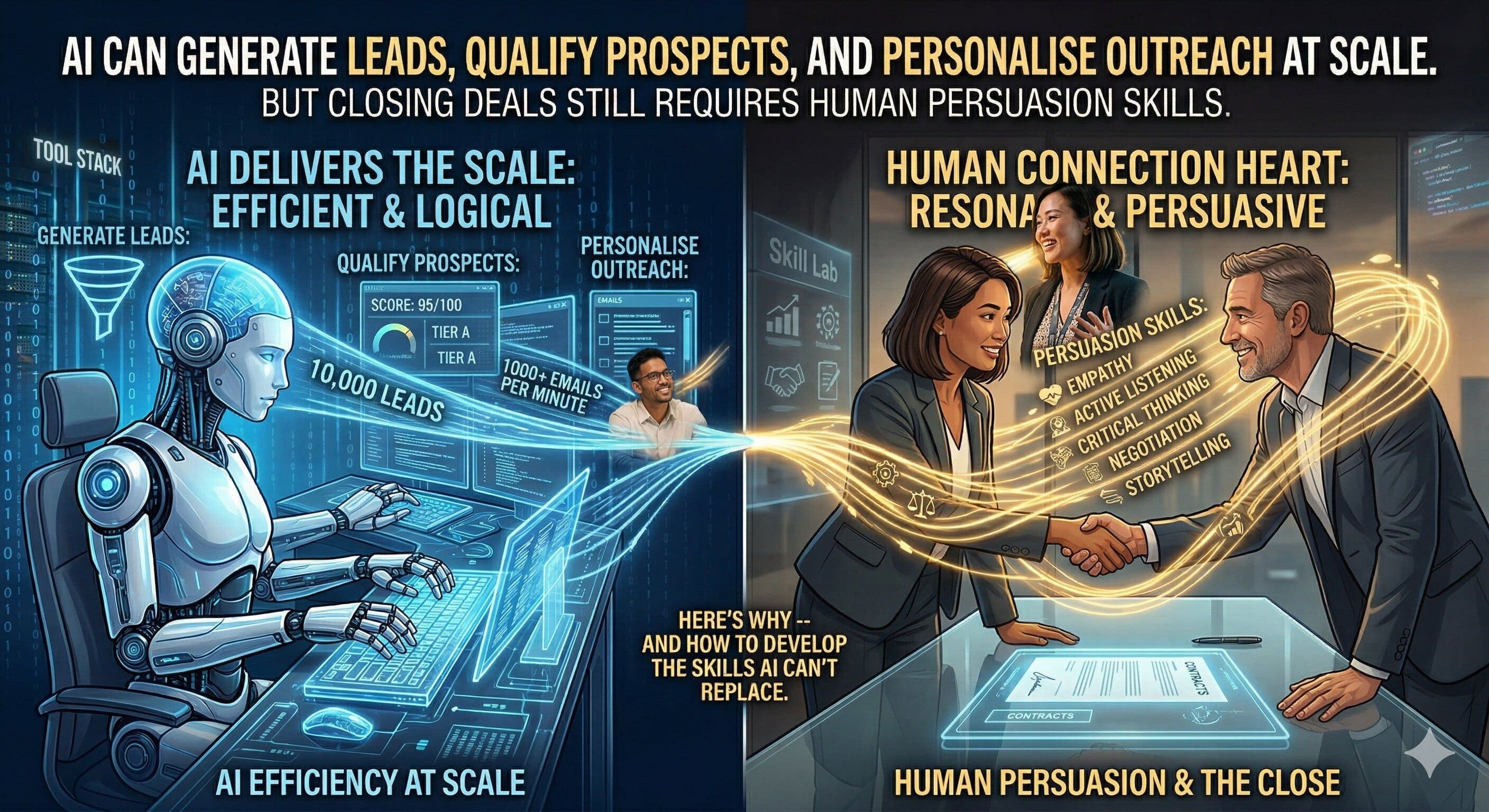
AI Delivers the Lead. Your Team Delivers the Close.
AI has transformed the top of the sales funnel beyond recognition. Lead scoring algorithms identify high-intent prospects before a human ever sees them. Automated outreach sequences personalise messaging at scale. Intent data platforms surface buyers who are actively researching solutions. Chatbots qualify prospects 24/7.
At LocalLead.ai, we've built our entire platform around this premise: AI can find the right prospect, at the right time, with the right message.
But here's the honest truth we tell every client: AI delivers the lead. It doesn't close the deal.
The moment a qualified prospect picks up the phone, joins a Zoom call, or walks into a meeting, the technology stops being the differentiator. What matters now is fundamentally human: how your salesperson communicates, persuades, listens, and responds in real-time.
And this is where most AI-powered sales teams have a critical gap. They've invested heavily in the technology that generates opportunities -- but underinvested in the human skills that convert those opportunities into revenue.
The Handoff Problem: Why Great Leads Die in Bad Conversations
We track lead-to-close conversion rates across our platform, and the data reveals a consistent pattern: companies with the best AI-driven lead generation don't always have the best close rates.
In fact, some of the most sophisticated AI implementations we've seen have mediocre conversion rates -- not because the leads are poor, but because the sales conversations don't match the quality of the lead intelligence.
Here's what the typical failure looks like:
- AI identifies a high-intent lead with detailed context (company size, tech stack, recent behaviour, likely pain points)
- The lead is routed to a sales rep with all this intelligence
- The rep opens the call with a generic script that ignores 90% of the AI-provided context
- The prospect, who expected a tailored conversation, mentally disengages
- The call ends with a polite "send me more information" -- the universal brush-off
The lead was perfect. The handoff killed it. And the problem isn't the script -- it's the delivery.
The 4 Human Skills AI Can't Replicate in Sales Conversations
1. Real-Time Persuasion
Once AI delivers the lead, your sales team needs 12 persuasion techniques backed by psychology to convert the conversation. The most effective sales conversations aren't scripted pitches -- they're dynamic applications of persuasion principles adapted to what the prospect reveals in real-time:
- Mirroring and matching: Reflecting the prospect's language, pace, and energy level to build unconscious rapport
- Problem agitation: Deepening the prospect's awareness of their pain before presenting the solution ("So if I understand correctly, this issue is costing your team about 15 hours per week -- and that's been going on for how long?")
- Social proof with specificity: "A logistics company your size -- about 200 employees, similar tech stack -- saw a 34% reduction in lead response time within 60 days"
- Loss framing: "The question isn't really what this solution costs. It's what you're losing every month you don't have it."
AI can suggest which persuasion approach to use based on prospect data. But executing that approach -- reading the room, adjusting tone, calibrating timing, handling objections with grace -- is irreducibly human.
Persuasion techniques that transform communication aren't just for marketers or public speakers. They're the core operating system of every successful sales professional -- and they're trainable.
2. Vocal Delivery on Discovery Calls
Here's something sales leaders rarely discuss: on a phone or video call, your voice carries the entire relationship.
There's no body language to compensate for a flat delivery. No impressive office to signal authority. No firm handshake to establish trust. It's just your voice, your words, and how you use them.
On discovery calls, 8 vocal techniques for speakers like pacing and emphasis determine whether a prospect stays engaged or starts checking email:
- Pacing control: Slowing down when discussing the prospect's specific pain points signals that you're taking their situation seriously. Speeding up through your own company's background signals confidence and keeps the call moving.
- Strategic emphasis: "We can reduce your response time by sixty-seven percent" lands differently when the number is emphasised versus buried in a monotone sentence.
- The power of the pause: After asking a discovery question, pause. Let the silence work. Most sales reps rush to fill gaps, which prevents the prospect from revealing deeper information.
- Vocal warmth vs. authority: Opening with warmth ("Thanks for making the time -- I know your schedule is packed") and transitioning to authority when presenting the solution ("Based on what you've shared, here's exactly what I'd recommend") builds both trust and credibility.
Sales reps who develop vocal techniques see measurable improvements in call duration, second-meeting conversion, and prospect engagement scores.
3. Handling Objections Under Pressure
Objections are where deals are won or lost. And they're the moment where AI can't help you.
"Your price is too high." "We're already talking to your competitor." "I need to think about it." "Can you send me a proposal?"
These aren't requests for information -- they're communication moments that require real-time human judgment:
- Reading the subtext: "I need to think about it" often means "I'm not convinced yet" -- not "I need time." The right response addresses the underlying doubt, not the surface request.
- Emotional calibration: A prospect who raises a price objection defensively needs a different response than one who raises it matter-of-factly. Same words, different emotional tone, different best response.
- Composure: Maintaining vocal steadiness when challenged signals confidence. Defensive tone, rapid speech, or over-explanation signals insecurity.
4. High-Stakes Presentation Confidence
First-time sales reps presenting to enterprise buyers face the same anxiety as stage performers. The physiological response is identical -- racing heart, dry mouth, scattered thoughts -- and it directly impacts the quality of their delivery.
Stage fright techniques that work for professionals apply directly to sales contexts:
- The "first 90 seconds" rule: Prepare and rehearse the opening 90 seconds of any sales presentation until it's automatic. This gets you through the highest-anxiety window.
- Reframe the stakes: "I'm not trying to close a deal. I'm trying to help this person solve a real problem." This cognitive shift reduces performance anxiety because it changes the frame from evaluation to service.
- Breathing reset: Between agenda items, take a deliberate slow breath while "reviewing notes." This prevents the cumulative anxiety build-up that makes sales presentations deteriorate over time.
- Planned recovery moments: Know what to say if you lose your train of thought: "Let me come back to that point -- I want to make sure I'm being precise about these numbers." This turns a potential embarrassment into a credibility signal.
Building the AI + Human Sales Stack
The winning formula isn't AI or human skills. It's AI plus human skills, with clear roles for each:
| Sales Stage | AI's Role | Human's Role |
|---|---|---|
| Prospecting | Identify and score leads | Build mental model of the prospect's world |
| Outreach | Personalise at scale, optimise timing | Craft the tone and message that feels genuinely human |
| Discovery | Provide prospect intelligence and context | Listen, ask deep questions, read emotional cues |
| Presentation | Generate data-driven slides and proposals | Deliver with conviction, handle Q&A with composure |
| Objection handling | Suggest responses based on historical patterns | Read the room, calibrate tone, address underlying concerns |
| Closing | Track engagement signals and timing | Create the moment of decision through trust and urgency |
The sales teams that outperform aren't choosing between AI efficiency and human connection. They're using AI to create more high-quality conversations -- and then ensuring their people are skilled enough to make those conversations count.
Practical Steps for Sales Leaders
1. Audit your conversion by stage. If AI-generated leads have high quality scores but low close rates, the problem is in the human conversation layer, not the technology.
2. Invest in communication training alongside tool training. For every dollar spent on sales technology, allocate proportional budget to developing the human skills that make that technology productive. Communication experts like Seyrul Consulting offer frameworks specifically designed for professionals who need to persuade, present, and perform under pressure.
3. Record and review sales calls. Not for compliance -- for vocal delivery development. Listen to your best closers. They use pacing, emphasis, and warmth in ways your average reps don't. Make those patterns visible and trainable.
4. Normalise practice. Elite athletes practise their skills daily. Elite salespeople should too. Role-play objection handling, rehearse presentations aloud, and conduct mock discovery calls with feedback. The teams that practise professional communication consulting fundamentals outperform those that only practise when it's real.
The Bottom Line
AI is the most powerful lead generation technology ever created. It finds the right people, at the right time, with the right message. But it can't sit across from a sceptical CFO and explain why this investment is the right one. It can't hear the hesitation in a prospect's voice and respond with exactly the right reassurance. It can't make a buyer feel understood, valued, and confident in their decision.
Those are human skills. Persuasion skills. Communication skills. And they're the skills that turn AI-generated leads into closed revenue.
The future of sales isn't AI replacing humans. It's AI amplifying humans who are skilled enough to deserve the amplification.
Key Takeaways
- AI excels at lead generation but can't close deals -- the conversion conversation is fundamentally human
- Four human skills remain irreplaceable: real-time persuasion, vocal delivery, objection handling, and high-stakes confidence
- The "handoff problem" -- great leads dying in bad conversations -- is a communication gap, not a technology gap
- The winning formula is AI + human skills, with clear roles at each stage of the sales process
- Sales leaders should invest in communication training proportionally to technology investment