
How Modern Platforms Verify WhatsApp and Email Contacts Automatically
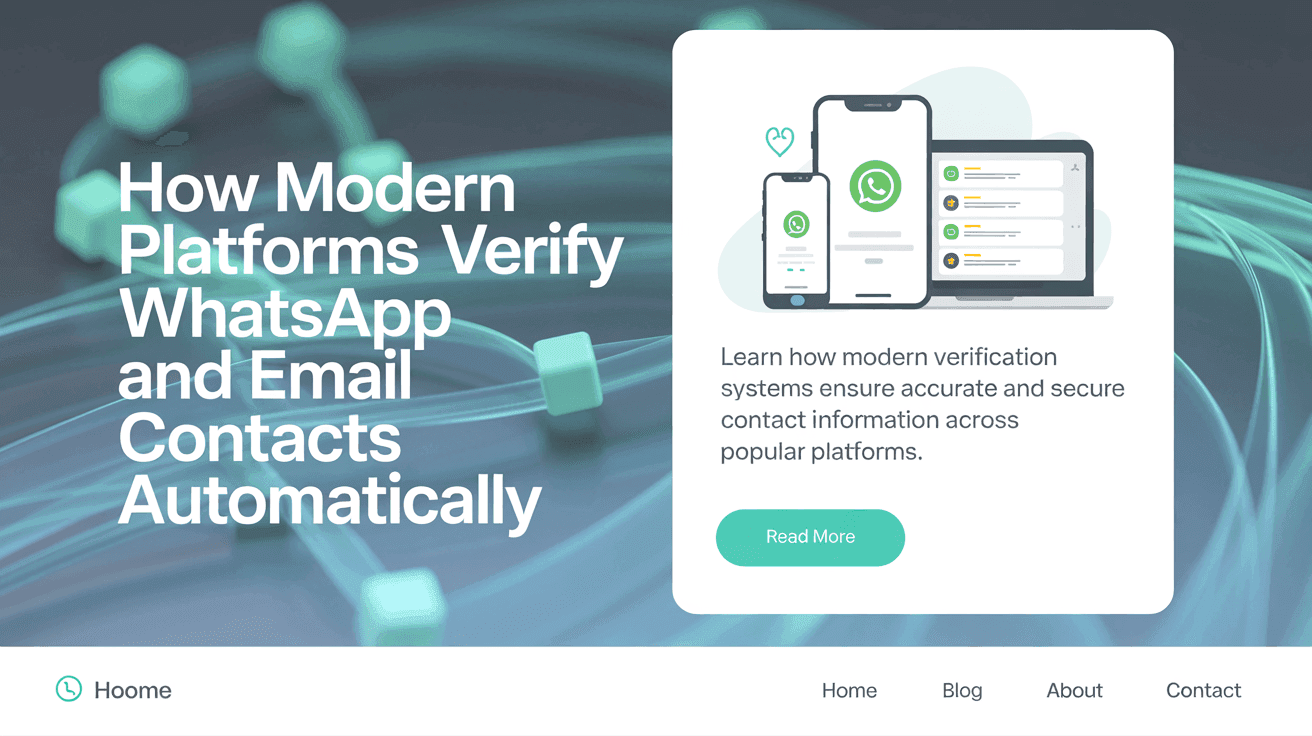
Table Of Contents
- Understanding Automated Contact Verification
- The Technology Behind Email Verification
- WhatsApp Contact Verification Methods
- AI's Role in Modern Contact Verification
- Benefits of Automated Contact Verification
- Implementing Automated Verification in Your Business
- Overcoming Common Verification Challenges
- Future Trends in Contact Verification
- Conclusion: Embracing Automated Contact Verification
In today's digital landscape, maintaining accurate contact information is critical for businesses seeking to effectively communicate with prospects and customers. Outdated or incorrect contact details not only waste resources but also damage brand credibility and potential relationships. This is where automated contact verification becomes essential.
Modern businesses rely heavily on WhatsApp and email for communication, making the verification of these channels particularly important. But how exactly do contemporary platforms verify these contacts automatically? What technologies enable seamless validation without manual intervention?
This article explores the sophisticated mechanisms behind automated contact verification systems, examining how cutting-edge platforms leverage AI, APIs, and specialized algorithms to ensure contact data integrity. We'll delve into the specific methods used for both email and WhatsApp verification, highlight the business benefits of implementing these systems, and provide guidance on selecting the right verification tools for your organization's needs.
Automated Contact Verification
How modern platforms verify WhatsApp and email contacts
Email Verification
- Syntax Validation - Checks format patterns and character rules
- Domain Verification - Confirms domain exists with DNS and MX records
- Mailbox Verification - Tests if specific mailbox exists on server
- SMTP Authentication - Simulates mail transaction to validate
WhatsApp Verification
- Number Formatting - Validates international formats and standards
- API-Based Verification - Uses WhatsApp Business API to check registration
- Two-Factor Authentication - Confirms number can receive messages
- Real-time Validation - Instantaneous confirmation of active numbers
AI's Role in Modern Verification
Pattern Recognition
Identifies patterns in valid vs. invalid contacts
Predictive Analytics
Assesses likelihood of validity based on historical data
NLP Capabilities
Analyzes address components for legitimacy
Business Benefits of Automated Verification
Improved Data Quality
Ensures databases contain accurate information
Reduced Bounce Rates
Decreases from 15-25% to 2-3%
Higher Conversions
Improves ROI and marketing performance
Cost Efficiency
Avoid paying for unusable data
Future Trends in Contact Verification
Blockchain for Verification
Predictive Verification
Cross-Channel Verification
Behavioral Validation
Transform Your Lead Generation Process
Start verifying contacts automatically to increase data accuracy and improve marketing ROI
Data accuracy is essential for effective business communication
Understanding Automated Contact Verification
Automated contact verification refers to the process of systematically confirming the validity and accessibility of communication channels—primarily email addresses and phone numbers—without manual intervention. Unlike traditional methods that might involve sending test messages or making confirmation calls, modern verification happens instantaneously through sophisticated technological processes.
The core principle behind automated verification is simple: determine whether a contact point actually exists and can receive communications. However, the implementation is complex, involving multiple validation layers and verification techniques that work in concert to deliver reliable results.
For businesses, particularly those focused on lead generation and marketing, automated verification serves as a critical first line of defense against data degradation. With studies showing that contact databases deteriorate by approximately 22.5% annually, maintaining clean contact lists is not merely good practice—it's essential for operational efficiency.
The Technology Behind Email Verification
Email verification technologies have evolved significantly, moving beyond simple regex patterns to comprehensive validation systems. Modern platforms employ a multi-layered approach to ensure maximum accuracy when verifying email addresses.
Syntax Validation
The most basic level of email verification involves checking that an email address follows the correct format. Verification systems analyze the structure of an address against established patterns, confirming elements such as:
- Presence of a single @ symbol
- Valid characters in the local part (before the @)
- Proper domain formatting
- Correct use of dots and special characters
While syntax checks catch obvious errors, they're just the beginning of a robust verification process. An email might have perfect syntax but still be unusable if the domain doesn't exist or the mailbox is inactive.
Domain Verification
After syntax validation, verification systems check whether the domain portion of the email (the part after the @) actually exists and can receive email. This typically involves:
- DNS lookups to confirm the domain is registered
- MX record checks to verify the domain has mail servers configured
- Analysis of domain reputation and age to identify potential spam domains
Domain verification effectively eliminates addresses with non-existent or improperly configured domains, which would inevitably bounce if contacted.
Mailbox Verification
The most sophisticated aspect of email verification involves confirming that the specific mailbox exists on the domain's mail server. Verification platforms connect to the mail server and simulate the beginning of an email sending process—without actually sending a message—to determine if the mailbox exists.
This process, often called SMTP validation or mailbox existence checking, provides the highest level of confidence that an email is valid and deliverable. However, it requires technical sophistication to implement correctly and respect mail server limitations.
SMTP Authentication
Some advanced verification systems go a step further by attempting SMTP authentication. This process checks whether the mail server accepts the email address as valid during the initial stages of a mail transaction.
The verification platform connects to the recipient's mail server and initiates the SMTP handshake process, which includes:
- Establishing a connection to the mail server
- Identifying itself (HELO/EHLO command)
- Providing the sender address (MAIL FROM command)
- Attempting to set the recipient (RCPT TO command)
The mail server's response to the RCPT TO command reveals whether the mailbox exists. If the server accepts the recipient, the address is valid; if it rejects it, the address is invalid.
WhatsApp Contact Verification Methods
Verifying WhatsApp contacts presents different challenges compared to email verification, largely because WhatsApp operates as a closed ecosystem with specific requirements for number activation.
Number Formatting and Validation
The first step in WhatsApp verification involves ensuring that phone numbers are formatted correctly according to international standards. This includes:
- Proper country code inclusion
- Removal of special characters and spaces
- Conformity to expected length and format for the specific country
Modern verification platforms maintain comprehensive databases of international phone number formats and requirements, allowing them to validate and standardize numbers from virtually any country.
API-Based Verification
WhatsApp provides official APIs that businesses can leverage for verification purposes. The WhatsApp Business API allows platforms to:
- Check if a number is registered with WhatsApp
- Verify the status of a WhatsApp account
- Determine messaging eligibility
Third-party verification services often integrate directly with these APIs to provide real-time validation of WhatsApp numbers. For businesses using the AI Local Business Discovery platform, these API integrations happen seamlessly in the background, ensuring that only valid WhatsApp contacts are included in lead lists.
Two-Factor Authentication Integration
Many modern platforms combine WhatsApp verification with two-factor authentication (2FA) processes. This approach serves two purposes:
- It confirms the number is valid and can receive messages
- It verifies that the user has access to the number
This method typically involves sending a one-time password (OTP) via WhatsApp and requiring the user to enter it on the platform. While primarily used for security purposes, this process simultaneously validates that the WhatsApp number is active and accessible.
AI's Role in Modern Contact Verification
Artificial intelligence has revolutionized contact verification by introducing capabilities that go far beyond traditional rule-based systems. AI-powered verification platforms like those developed by HashMeta AI leverage machine learning algorithms to:
- Identify patterns in valid vs. invalid contacts
- Detect disposable or temporary email domains
- Recognize synthetic or machine-generated addresses
- Adapt to new validation challenges without manual updates
Predictive analytics also plays a crucial role in modern verification systems. By analyzing historical data, AI can assess the likelihood of an email address or phone number being valid, even when direct verification methods are inconclusive.
For example, if a domain has historically shown a high rate of invalid mailboxes or if a certain pattern of email address construction frequently correlates with bounces, the system can flag these as potential issues even if basic verification checks pass.
Natural language processing (NLP) capabilities further enhance verification by analyzing address components for legitimacy. NLP can identify suspicious patterns, detect keyboard patterns or random strings, and even evaluate whether name components in email addresses appear authentic.
Benefits of Automated Contact Verification
Implementing automated contact verification delivers numerous benefits that directly impact business performance:
Improved Data Quality: Verification ensures that contact databases contain accurate, usable information. This foundation of clean data supports all subsequent marketing and sales activities.
Reduced Bounce Rates: By identifying and removing invalid email addresses before campaigns launch, businesses see dramatic reductions in bounce rates—often from industry averages of 15-25% down to 2-3%.
Enhanced Sender Reputation: Email service providers track sender reputation based partly on bounce rates. Lower bounces mean better deliverability for all campaigns, creating a virtuous cycle of improved performance.
Cost Efficiency: Most email marketing and CRM platforms charge based on the number of contacts. By removing invalid contacts, businesses avoid paying for unusable data.
Higher Conversion Rates: When marketing efforts reach only valid contacts, conversion metrics naturally improve, providing more accurate performance data and better ROI.
Compliance Support: Many data protection regulations require maintaining accurate data and removing outdated information. Verification helps meet these compliance requirements.
For businesses utilizing platforms like BusinessPlusAI, these benefits translate directly to improved lead generation outcomes and more efficient marketing operations.
Implementing Automated Verification in Your Business
Integrating automated contact verification into your business processes requires strategic planning and consideration of several key factors:
Choose the Right Verification Level: Different business contexts require different verification depths. E-commerce might need only basic validation, while financial services may require the most thorough verification possible.
Select Integration Points: Determine where verification should occur in your business processes—at data entry, before campaign launches, during periodic database cleanings, or all three.
Balance Accuracy vs. Speed: More thorough verification typically takes longer. Consider whether your use case prioritizes absolute accuracy or requires rapid processing.
Consider Real-time vs. Batch Processing: Real-time verification works well for point-of-capture scenarios (like web forms), while batch processing suits large database cleanups.
Evaluate API Requirements: If you're building verification into custom applications, assess the API capabilities, rate limits, and integration requirements of potential verification services.
Many businesses find that the most effective approach combines multiple verification methods. For instance, using syntax and domain validation in real-time during form submission, followed by more thorough SMTP checks before adding contacts to marketing automation systems.
Overcoming Common Verification Challenges
While automated verification offers significant advantages, several challenges can arise during implementation:
Mail Server Limitations: Some mail servers implement protective measures that block verification attempts, resulting in false negatives.
Catch-all Domains: These domains accept all email addresses regardless of whether specific mailboxes exist, making traditional mailbox verification ineffective.
Corporate Firewalls: Enterprise email systems often have security measures that interfere with verification processes.
Privacy Regulations: Certain verification methods may raise questions under privacy regulations like GDPR, particularly those involving processing personal data.
Modern verification platforms address these challenges through sophisticated techniques:
- Implementing IP rotation and throttling to avoid triggering spam filters
- Using historical data and machine learning to make educated assessments of catch-all domains
- Employing alternative verification methods when primary approaches are blocked
- Ensuring all processes comply with relevant data protection regulations
Businesses using AI SEO Agents or AI Chat Agents can leverage these advanced capabilities without managing the technical complexities themselves.
Future Trends in Contact Verification
The contact verification landscape continues to evolve rapidly, with several emerging trends shaping the future of this technology:
Blockchain for Verification: Blockchain technology is beginning to influence contact verification by providing immutable, decentralized identity verification methods.
Predictive Verification: Advanced AI is moving beyond reactive verification to predict when contacts are likely to become invalid, allowing proactive database maintenance.
Cross-Channel Verification: Newer systems verify contacts across multiple channels simultaneously, confirming consistency between email, phone, social media, and messaging platforms.
Behavioral Validation: Beyond technical verification, systems are starting to incorporate behavioral signals to determine if contacts are not just valid but actively engaged.
Integration with Customer Data Platforms: Verification is increasingly becoming a core component of unified customer data platforms rather than a standalone function.
As these trends mature, we can expect even more sophisticated verification capabilities that further reduce the friction between businesses and their contacts while maintaining the highest standards of data quality.
Conclusion: Embracing Automated Contact Verification
Automated contact verification has evolved from a nice-to-have feature to an essential component of effective business communication. As we've explored throughout this article, modern verification systems employ sophisticated techniques to validate both email addresses and WhatsApp contacts, ensuring that businesses maintain clean, accurate contact databases.
The benefits of implementing these verification systems extend far beyond simply reducing bounce rates. Improved sender reputation, enhanced compliance, cost savings, and increased conversion rates all contribute to a stronger return on marketing investments and more efficient operations.
As AI continues to advance, we can expect verification technologies to become even more accurate, intelligent, and seamlessly integrated into business processes. The future of contact verification lies in proactive data management, cross-channel validation, and deeper integration with customer intelligence platforms.
For businesses looking to stay competitive in an increasingly digital marketplace, investing in robust contact verification is no longer optional—it's a strategic necessity that directly impacts the bottom line. By ensuring that every contact point is valid and accessible, organizations can build stronger relationships with their audiences and maximize the effectiveness of their communication efforts.
Ready to transform your lead generation process with AI-powered contact verification? Visit LocalLead.ai today to discover how our intelligent platform can help you identify, verify, and connect with high-quality leads while eliminating the frustrations of outdated contact information.