
How to Build a B2B Sales Funnel Using Verified Contacts
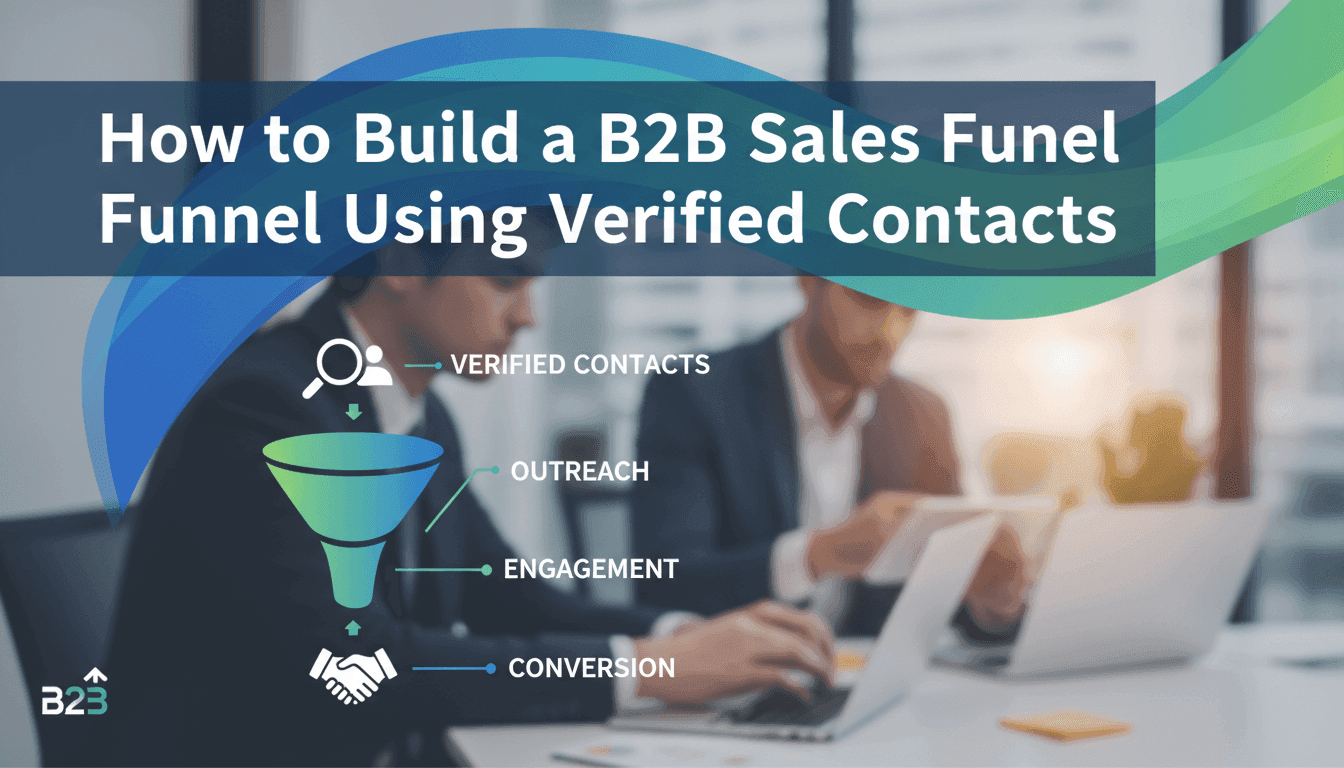
Table Of Contents
- Understanding the B2B Sales Funnel
- Why Verified Contacts Are Critical to Your Sales Funnel Success
- The Six Essential Stages of a B2B Sales Funnel
- How to Build Your B2B Sales Funnel Step-by-Step
- Contact Verification Methods and Best Practices
- Optimizing Your Funnel with Verified Contact Data
- Key Metrics and Conversion Benchmarks
- Common Pitfalls to Avoid When Building Your Sales Funnel
- The Future of B2B Sales Funnels: AI-Driven Lead Generation
The foundation of any successful B2B sales strategy starts with one crucial element: reaching the right people with the right message at the right time. Yet according to recent industry data, contact databases can decay by approximately 25-35% annually due to job changes, company restructures, and outdated information. This means nearly a third of your carefully built contact list could be leading your sales team to dead ends, costing valuable time and resources.
Building a B2B sales funnel using verified contacts solves this fundamental challenge. When your sales funnel is powered by accurate, up-to-date contact information, your team can focus on what truly matters: nurturing relationships and closing deals, rather than chasing invalid emails and disconnected phone numbers.
In this comprehensive guide, you'll learn how to construct a high-performing B2B sales funnel that leverages verified contacts at every stage. We'll explore the essential funnel stages, proven verification methods, optimization strategies, and industry benchmarks that will help you maximize conversion rates and ROI. Whether you're building your first sales funnel or refining an existing one, understanding how to integrate verified contact data into your process is the key to sustainable growth.
Build a High-Converting B2B Sales Funnel
Leverage verified contacts to maximize ROI at every stage
The Data Decay Problem
25-35%of contact databases decay annually due to job changes and outdated information. That's nearly 1 in 3 contacts leading to dead ends.
The 6 Essential Funnel Stages
Awareness
Capture attention with educational content. Identify engaging companies for targeted nurture campaigns.
Interest
Prospects seek more info. Prime territory for targeted email campaigns to verified decision-makers.
Consideration
Multi-threading essential. Need verified contacts for technical evaluators, financial decision-makers, and executives.
Intent
High-intent signals emerge. Direct mobile numbers and emails for key decision-makers become critical.
Evaluation
Final purchasing decision. Contact data must be current—personnel changes can derail deals.
Purchase & Retention
Monitor stakeholder changes, maintain relationships, and prevent churn. Customer retention can increase revenue by 25-95%.
Why Verified Contacts Drive Success
Higher conversion rates with accurate data
Target bounce rate for healthy deliverability
Accuracy with human verification methods
B2B Conversion Benchmarks
Visitor → Lead
1-5% depending on traffic quality
MQL → SQL
Marketing to Sales Qualified Lead
SQL → Opportunity
Qualified lead to active opportunity
Opportunity → Closed-Won
Final conversion to customer
Key Best Practices
Re-verify Regularly
Update active segments every 90-180 days to maintain accuracy
Multi-Thread Accounts
Engage multiple stakeholders within target organizations
Personalize at Scale
Use verified data for industry, role, and tech stack personalization
Monitor Bounce Rates
Keep hard bounces below 1% for optimal deliverability
Implement Lead Scoring
Prioritize prospects by fit and engagement signals
Align Sales & Marketing
Unified contact data and shared lead definitions
Ready to Transform Your Sales Funnel?
Stop wasting resources on outdated data. Leverage AI-driven lead generation with real-time verification and intelligent matching.
Discover LocalLead.aiUnderstanding the B2B Sales Funnel
A B2B sales funnel represents the journey that potential customers take from first discovering your business to becoming paying clients. Unlike B2C funnels, which often involve quick, emotion-driven purchases, B2B sales funnels are characterized by longer decision cycles, multiple stakeholders, and higher transaction values.
The funnel metaphor illustrates how a large number of prospects enter at the top (awareness stage) and progressively narrow down as they move through each stage, with only qualified, engaged leads ultimately converting at the bottom. Understanding this progression is essential because it allows you to tailor your approach, content, and outreach strategy to match where prospects are in their buying journey.
What sets B2B funnels apart is their complexity. Purchase decisions often involve committees of 6-10 decision-makers, each with different priorities and concerns. The sales cycle can extend from several weeks to many months, depending on deal size and organizational complexity. This extended timeline makes contact data quality even more critical because outdated information can derail deals at any stage.
Why Verified Contacts Are Critical to Your Sales Funnel Success
Verified contacts form the bedrock of an effective B2B sales funnel. Without accurate contact information, even the most brilliant sales strategy falls flat. Here's why verification matters at every stage of your funnel.
Protecting Your Sender Reputation
When you send emails to invalid addresses, your bounce rate increases. High bounce rates (typically above 2-3%) signal to email service providers that you may be a spammer, damaging your sender reputation and reducing inbox placement rates for all future emails. Industry best practices recommend keeping hard bounces at or below 1% to maintain healthy deliverability.
Improving Conversion Rates
Companies with accurate data see over 60% higher conversion rates than those working with outdated information. When your sales team contacts the right person at the right company with current contact details, the likelihood of meaningful engagement skyrockets. You're not wasting time on leads who have already left the company or changed roles.
Reducing Wasted Resources
Every minute your sales representatives spend researching contact information, correcting bounced emails, or calling disconnected numbers is time not spent selling. Verified contacts allow your team to focus their energy on high-value activities like relationship building, needs discovery, and closing deals.
Ensuring Compliance
Data privacy regulations like GDPR and CCPA require businesses to handle contact information responsibly. Working with verified, compliant contact databases helps you avoid legal risks, potential fines, and reputational damage that comes from using data obtained through questionable means.
The Six Essential Stages of a B2B Sales Funnel
While specific B2B sales funnels vary by industry and business model, most follow six core stages. Understanding each stage helps you deploy the right tactics and verified contacts at the right moment.
1. Awareness Stage
At the top of the funnel, potential customers first become aware of their problem and begin researching solutions. They may discover your brand through content marketing, social media, search engines, or industry events. At this stage, prospects are typically not ready to buy but are gathering information.
Your Goal: Capture attention and position your brand as a trusted resource. Use educational content like blog posts, whitepapers, and webinars that address common pain points your ideal customers face.
Role of Verified Contacts: While direct outreach may be minimal at this stage, having verified contact data allows you to identify which companies are engaging with your content and begin building targeted lists for nurture campaigns.
2. Interest Stage
Prospects move to the interest stage when they recognize your solution might be relevant to their needs. They actively seek more information by downloading resources, attending demos, or responding to outreach. This is where your verified contacts become actionable.
Your Goal: Provide educational content that demonstrates your understanding of their challenges and showcases how similar companies have benefited from your solution.
Role of Verified Contacts: This is prime territory for targeted email campaigns and personalized outreach to verified decision-makers. Knowing the exact job titles, company sizes, and industries within your contact database allows for highly relevant messaging.
3. Consideration Stage
During consideration, prospects evaluate whether your offering truly addresses their specific pain points. They're comparing your solution against competitors and building consensus among internal stakeholders. The middle-of-funnel questions shift from "why" to "how" and "who."
Your Goal: Differentiate your solution by highlighting unique value propositions, sharing detailed case studies, and providing product comparisons that position you favorably against alternatives.
Role of Verified Contacts: Multi-threading becomes essential here. You need verified contact information for multiple stakeholders within target accounts, including technical evaluators, financial decision-makers, and executive sponsors.
4. Intent Stage
Prospects in the intent stage have moved beyond exploration to serious evaluation. They request pricing information, attend detailed product demonstrations, and may begin negotiating terms. These are high-intent signals that indicate readiness to move forward.
Your Goal: Build trust through transparent communication, address specific objections, and demonstrate clear ROI aligned with their business objectives.
Role of Verified Contacts: Accurate mobile numbers and direct email addresses for key decision-makers become critical. Deals can stall if you cannot reach the right people at crucial moments in the decision process.
5. Evaluation Stage
The evaluation stage represents the final purchasing decision. Buyers are weighing options, conducting technical evaluations, navigating internal procurement processes, and building business cases for stakeholder buy-in. This is where deals close or opportunities are lost.
Your Goal: Provide proof your solution works through tailored demos, technical documentation, and references from similar customers. Make the buying process as frictionless as possible.
Role of Verified Contacts: Contact data must be current because personnel changes during this stage can completely derail deals. Regular verification ensures you're always communicating with active decision-makers.
6. Purchase and Retention Stage
The journey doesn't end at purchase. Post-sale engagement, onboarding, and ongoing relationship building are what transform one-time buyers into long-term customers and brand advocates. Customer retention can increase company revenue by 25-95% according to industry research.
Your Goal: Ensure successful implementation, drive product adoption, and identify expansion opportunities within existing accounts.
Role of Verified Contacts: Verified customer contact lists help you identify when key stakeholders change roles or leave the company. This allows you to maintain relationships, follow champions to new organizations, and prevent churn caused by communication gaps.
How to Build Your B2B Sales Funnel Step-by-Step
Building an effective B2B sales funnel requires strategic planning, the right technology, and a commitment to data quality. Follow these steps to create a funnel that converts prospects into customers.
Step 1: Define Your Ideal Customer Profile (ICP)
Before you can build an effective funnel, you need crystal clarity on who you're trying to reach. Your ideal customer profile should include firmographic data such as industry, company size, revenue range, geographic location, and technology stack. On the individual level, identify job titles, departments, and roles of decision-makers and influencers.
A well-defined ICP ensures that every contact entering your funnel has the potential to become a valuable customer. It prevents wasted effort on prospects who will never convert, no matter how brilliant your sales approach.
Step 2: Map Your Customer Journey
Document the specific path your ideal customers take from problem awareness to purchase. What questions do they ask at each stage? What content do they consume? Who gets involved in the decision at different points? Understanding this journey allows you to create stage-specific strategies and identify exactly when and how verified contacts should be engaged.
For example, a SaaS company selling to enterprise clients might find that technical evaluators enter the conversation during the consideration stage, while C-level executives only engage during final evaluation. Your contact verification strategy should account for these different stakeholders.
Step 3: Select Your Sales Channels
Determine which channels you'll use to connect with prospects at each funnel stage. Options include email outreach, cold calling, LinkedIn engagement, content marketing, paid advertising, webinars, and in-person events. Most successful B2B companies adopt an omnichannel approach because research shows that less than 50% of B2B companies grow market share selling through just one channel.
Your verified contact database should support multi-channel engagement with email addresses, verified phone numbers, and social media profiles for key decision-makers.
Step 4: Build Your Verified Contact Database
This is where your funnel gains its competitive advantage. Rather than manually compiling contacts or purchasing outdated lists, invest in a solution that provides real-time, verified contact data. AI Local Business Discovery platforms leverage advanced algorithms to identify active, relevant leads matched to your exact ICP specifications.
Look for contact database solutions that offer:
- Real-time verification that confirms email deliverability and phone number accuracy before you reach out
- Regular updates to account for job changes and company restructures
- Comprehensive data including direct dials, verified emails, job titles, and company information
- Compliance assurance with GDPR, CCPA, and other data privacy regulations
- Advanced filtering by industry, location, company size, technology stack, and other relevant criteria
Many businesses struggle with outdated data and poor lead matching. An AI-driven platform addresses these challenges by continuously discovering new leads and updating existing contact information automatically.
Step 5: Create Stage-Specific Content
Develop content assets tailored to each funnel stage. Top-of-funnel content should be educational and problem-focused (blog posts, industry reports, educational webinars). Middle-funnel content demonstrates your expertise and solution value (case studies, product comparison guides, ROI calculators). Bottom-funnel content removes final barriers to purchase (pricing information, technical specifications, customer testimonials, free trials).
When you have verified contact data, you can deliver this content directly to the right people via targeted email campaigns, rather than hoping they discover it through organic search.
Step 6: Implement Lead Scoring and Qualification
Not all contacts in your database deserve equal attention. Implement a lead scoring system that assigns points based on firmographic fit (company size, industry, revenue), demographic fit (job title, seniority), and behavioral engagement (email opens, content downloads, website visits, demo requests).
Verified contact data enhances lead scoring accuracy because you're working with confirmed information about company and individual characteristics. This allows your sales team to prioritize prospects most likely to convert.
Step 7: Align Sales and Marketing Teams
The most effective sales funnels require tight collaboration between marketing and sales. Marketing should attract the right leads and create valuable content, while sales delivers that content at optimal times and closes deals. Establish clear definitions for lead stages (MQL, SQL, opportunity) and create service-level agreements about lead follow-up timing and handoff processes.
Shared access to verified contact data ensures both teams work from the same accurate information, eliminating confusion about lead ownership and status.
Step 8: Set Up Automation and CRM Integration
Implement marketing automation and CRM systems to manage contact data, track interactions, and trigger appropriate follow-up actions. Your verified contact database should integrate seamlessly with platforms like Salesforce, HubSpot, or Pipedrive, allowing automatic enrichment of contact records and real-time sync.
Automation ensures no lead falls through the cracks and allows you to nurture thousands of contacts simultaneously with personalized, relevant communications based on their funnel stage and behavior.
Contact Verification Methods and Best Practices
Verification is not a single switch but a layered process with different approaches offering varying levels of accuracy, cost, and speed. Understanding these methods helps you choose the right verification strategy for your business needs.
Human Verification
Human-verified contacts involve researchers who confirm role, email, and phone information by hand or direct dial. This method offers the highest confidence, especially for senior titles and direct dial numbers. Industry sources cite human verification accuracy at approximately 95%.
The downside is cost and scalability. Human verification is more expensive and slower than automated methods, making it most appropriate for high-value target accounts where contact accuracy is mission-critical.
Email Verification
Email verification uses SMTP-level checks to validate that a mailbox is deliverable, with additional checks for catch-all handling and bounce prediction. This method is fast and cost-effective for large volumes, making it essential before launching cold email campaigns. Email verification typically achieves around 90% accuracy.
The limitation is that catch-all domains and transient server behavior can cause false results. Some emails may pass verification but still not reach the intended recipient.
Machine Learning Verification
AI and machine learning models aggregate data from multiple sources, analyze patterns, and predict contact accuracy based on historical validation data. These systems can process vast amounts of data quickly and often combine multiple verification signals.
Machine verification works well for initial contact discovery and large-scale database building, but should ideally be combined with email verification before outbound campaigns to ensure deliverability.
Best Practices for Maintaining Contact Quality
Re-verify Regularly: Contact data decays fast. Re-verify active segments every 90 to 180 days to maintain accuracy.
Monitor Bounce Rates: Keep hard bounces at or below 1% for any email campaign. If a list exceeds this threshold, pause the campaign and re-verify before continuing.
Implement Real-Time Verification: Verify new leads immediately as they enter your database, whether from form submissions, purchased lists, or data enrichment services.
Remove Duplicates and Inactive Contacts: Regularly clean your database to remove duplicate records and contacts who haven't engaged in 12+ months.
Segment by Verification Status: Tag contacts with their verification date and method, allowing you to prioritize the most recently verified contacts for high-stakes outreach.
Optimizing Your Funnel with Verified Contact Data
Once your funnel is built, optimization becomes an ongoing process. Verified contact data enables several powerful optimization strategies.
Personalize Outreach at Scale
Verified contact databases provide rich firmographic and demographic information beyond just email addresses. Use this data to personalize your messaging based on industry, company size, role, and technology stack. Personalized emails leveraging verified data see significantly higher response rates than generic mass outreach.
For instance, if your verified data shows a prospect uses specific technologies, reference those tools in your outreach and explain how your solution integrates or improves upon them.
Multi-Thread Within Target Accounts
Account-based marketing (ABM) requires engaging multiple stakeholders within the same organization. Verified contact databases give you access to entire buying committees, not just a single contact. Build relationships with technical evaluators, budget holders, and executive sponsors simultaneously to accelerate deal velocity.
Research shows deals close faster when multiple stakeholders are engaged early in the process.
Leverage Intent Data and Buying Signals
Advanced contact databases increasingly include intent signals like job changes, funding rounds, technology adoptions, and hiring trends. These signals indicate when a company may be in-market for your solution.
For example, if a company just received Series B funding, they likely have budget for new solutions. If they're actively hiring sales reps, they may need sales enablement tools. Combining these signals with verified contact information allows perfectly timed outreach.
Test and Refine Messaging
With accurate contact data, you can run controlled A/B tests on subject lines, email copy, call-to-action wording, and outreach timing. Because you're working with verified contacts, you know that differences in performance are due to messaging variations, not data quality issues.
Systematic testing across verified contact segments helps you identify what resonates with different buyer personas and continuously improve conversion rates.
Identify and Fix Conversion Leaks
Track conversion rates at each funnel stage and identify where prospects drop off. If you see high drop-off between interest and consideration stages, it may indicate your value proposition isn't resonating or you're not engaging the right stakeholders. If deals stall during evaluation, your sales team may need better tools to address objections or demonstrate ROI.
Verified contact data ensures these insights are based on actual engagement patterns rather than skewed by bounced emails and disconnected numbers.
Key Metrics and Conversion Benchmarks
Tracking the right metrics allows you to measure funnel performance and identify optimization opportunities. Here are the essential metrics for B2B sales funnels powered by verified contacts.
Conversion Rates by Stage
Conversion rates measure the percentage of prospects who successfully move from one funnel stage to the next. Industry benchmarks for B2B companies vary, but typical ranges include:
- Visitor to Lead: 1-5% depending on traffic quality and offer relevance
- Lead to MQL (Marketing Qualified Lead): 1-3% of total prospects
- MQL to SQL (Sales Qualified Lead): 10-26%
- SQL to Opportunity: 50-62%
- Opportunity to Closed-Won: 20-30%
These benchmarks provide context, but your specific rates will vary based on average deal size, sales cycle length, and industry. Track your own historical performance to identify trends and improvement areas.
Email Deliverability Metrics
When using verified contacts for email outreach, monitor:
- Bounce Rate: Hard bounces should stay below 1%
- Open Rate: Industry average for B2B is typically 15-25%
- Click-Through Rate: Average 2-5% for B2B emails
- Reply Rate: Cold emails to verified contacts often see 1-5% reply rates, with well-targeted campaigns achieving higher
Poor deliverability metrics often indicate data quality issues requiring re-verification.
Sales Velocity
Sales velocity measures how quickly deals move through your pipeline. The formula is: (Number of Opportunities × Average Deal Value × Win Rate) / Sales Cycle Length. Verified contacts accelerate sales velocity by reducing time wasted on bad data and allowing faster connection with decision-makers.
Customer Acquisition Cost (CAC)
CAC measures the total cost of acquiring a new customer, including marketing expenses, sales salaries, technology costs, and data costs. Verified contacts reduce CAC by improving conversion rates and eliminating wasted spend on undeliverable outreach.
Lead Response Time
This tracks how quickly your sales team follows up with new leads. Research consistently shows that response time dramatically impacts conversion rates, with leads contacted within 5 minutes being 21 times more likely to convert than those contacted after 30 minutes. Verified contact data with direct dials enables faster connection.
Pipeline Coverage
Pipeline coverage measures the ratio of pipeline value to quota. Most sales organizations need 3-5x pipeline coverage to reliably hit targets. Verified contacts help build healthier pipelines by ensuring the prospects you're adding are actually reachable and qualified.
Common Pitfalls to Avoid When Building Your Sales Funnel
Even with verified contacts, certain mistakes can undermine your sales funnel effectiveness. Avoid these common pitfalls.
Neglecting Data Maintenance
Verification is not a one-time activity. Contact information changes constantly as people switch jobs, companies reorganize, and phone numbers change. Failing to regularly re-verify and update your database creates the same problems you were trying to solve initially. Set up automated re-verification schedules and monitor data decay metrics.
Treating All Leads Equally
Not every contact in your verified database deserves the same level of attention. Companies that fail to implement lead scoring waste resources pursuing low-fit prospects while missing opportunities with high-value accounts. Prioritize based on both firmographic fit and behavioral engagement signals.
Focusing on a Single Channel
Relying exclusively on email outreach or cold calling limits your reach and effectiveness. Modern buyers engage across multiple channels and expect consistent experiences. Use your verified contact data to orchestrate multi-channel campaigns that include email, phone, social media, and direct mail.
Ignoring the Customer Experience
Your sales funnel doesn't end at purchase. Post-sale experience, onboarding quality, and ongoing support determine whether customers become long-term partners or churn. Use verified customer contact data to maintain relationships, identify when key stakeholders change, and proactively address issues before they lead to cancellations.
Over-Automating Without Personalization
While automation enables scale, excessive automation without personalization makes outreach feel robotic and impersonal. Balance efficiency with genuine human connection. Use automation to trigger outreach and manage workflows, but personalize messages based on the verified data you have about prospects' companies, roles, and challenges.
Failing to Align Sales and Marketing
When sales and marketing operate in silos with different definitions of lead quality and separate contact databases, opportunities fall through the cracks and resources are wasted. Establish shared goals, agreed-upon lead definitions, and unified access to verified contact data.
The Future of B2B Sales Funnels: AI-Driven Lead Generation
The landscape of B2B sales funnels continues to evolve rapidly, driven by advances in artificial intelligence and changing buyer behaviors. Understanding these trends helps future-proof your funnel strategy.
Real-Time Lead Discovery
Traditional contact databases quickly become outdated because they represent snapshots in time. The future belongs to platforms that continuously discover and verify leads in real-time, using AI to search the web, identify relevant businesses, and validate contact information on-demand.
This approach ensures you're always working with the freshest data possible. Rather than purchasing a static list that decays immediately, AI-driven platforms like LocalLead.ai continuously refresh contact information and discover new leads that match your evolving ICP.
Intelligent Lead Matching and Scoring
AI algorithms can analyze thousands of data points to predict which leads are most likely to convert, going far beyond simple demographic and firmographic scoring. Machine learning models consider behavioral patterns, technology adoption signals, organizational changes, and historical conversion data to surface your highest-probability opportunities.
This intelligent matching ensures your sales team spends time on leads with genuine potential rather than chasing unlikely prospects simply because their contact information is verified.
Predictive Analytics for Funnel Optimization
AI-powered analytics can predict where deals are likely to stall, which prospects are at risk of churning, and which marketing messages will resonate with specific segments. These insights allow proactive intervention before problems occur, optimizing conversion rates at every funnel stage.
Automated Personalization at Scale
Generative AI is making it possible to create highly personalized outreach messages for thousands of contacts simultaneously. These systems analyze verified contact data, company information, and recent news to craft contextually relevant messages that feel human-written while operating at machine scale.
The combination of verified contact data and AI-generated personalization creates outreach that is both scalable and genuinely relevant.
Continuous Learning and Improvement
Modern AI SEO Agents and AI Marketing Services platforms learn from every interaction, continuously refining lead scoring models, message optimization, and targeting strategies based on actual results. This creates a virtuous cycle where your funnel becomes more effective over time.
For businesses serious about scaling B2B sales, embracing AI-driven lead generation and verified contact management is no longer optional. The efficiency gains, conversion improvements, and resource savings make it a competitive necessity. Organizations that continue relying on manual prospecting and outdated contact databases will find themselves at an increasing disadvantage against competitors leveraging these advanced technologies.
Building a B2B sales funnel using verified contacts transforms your sales process from a frustrating game of chance into a predictable revenue engine. By ensuring every contact in your database is accurate, current, and deliverable, you eliminate the wasted time and resources that come from chasing bad data.
The key takeaways for success are clear: define your ideal customer profile precisely, map the specific journey your prospects take, select the right channels for engagement, and invest in verified contact data from the start. Build stage-specific content that addresses prospect needs at each phase, implement robust lead scoring, and ensure tight alignment between sales and marketing teams.
Most importantly, recognize that verification is an ongoing process, not a one-time task. Contact data decays continuously, making regular re-verification essential to maintaining funnel effectiveness. Combine human, email, and machine learning verification methods to balance accuracy, cost, and scale.
The metrics don't lie. Companies with accurate data see over 60% higher conversion rates, and maintaining verified contact databases directly impacts every key performance indicator from email deliverability to sales velocity to customer acquisition cost. When you can reach the right decision-makers consistently with personalized, relevant messaging, conversion rates improve across every funnel stage.
As buyer behaviors evolve and sales cycles become more complex, the competitive advantage increasingly belongs to organizations that leverage AI-driven platforms for real-time lead discovery and intelligent contact verification. These systems address the fundamental challenges of outdated data and poor lead matching that have plagued B2B sales teams for decades.
Whether you're building your first sales funnel or optimizing an existing one, prioritizing verified contact quality sets the foundation for sustainable growth. The right contacts, reached at the right time with the right message, make all the difference between struggling to hit quota and consistently exceeding targets.
Ready to transform your B2B sales funnel with AI-driven lead generation and verified contacts? Discover how LocalLead.ai streamlines lead discovery with real-time web searches, intelligent matching, and continuous updates of targeted leads tailored to your business requirements. Stop wasting resources on outdated data and start building a sales funnel that actually converts.