
National vs Local SEO: When to Optimize for Geo-Modified vs Generic Keywords
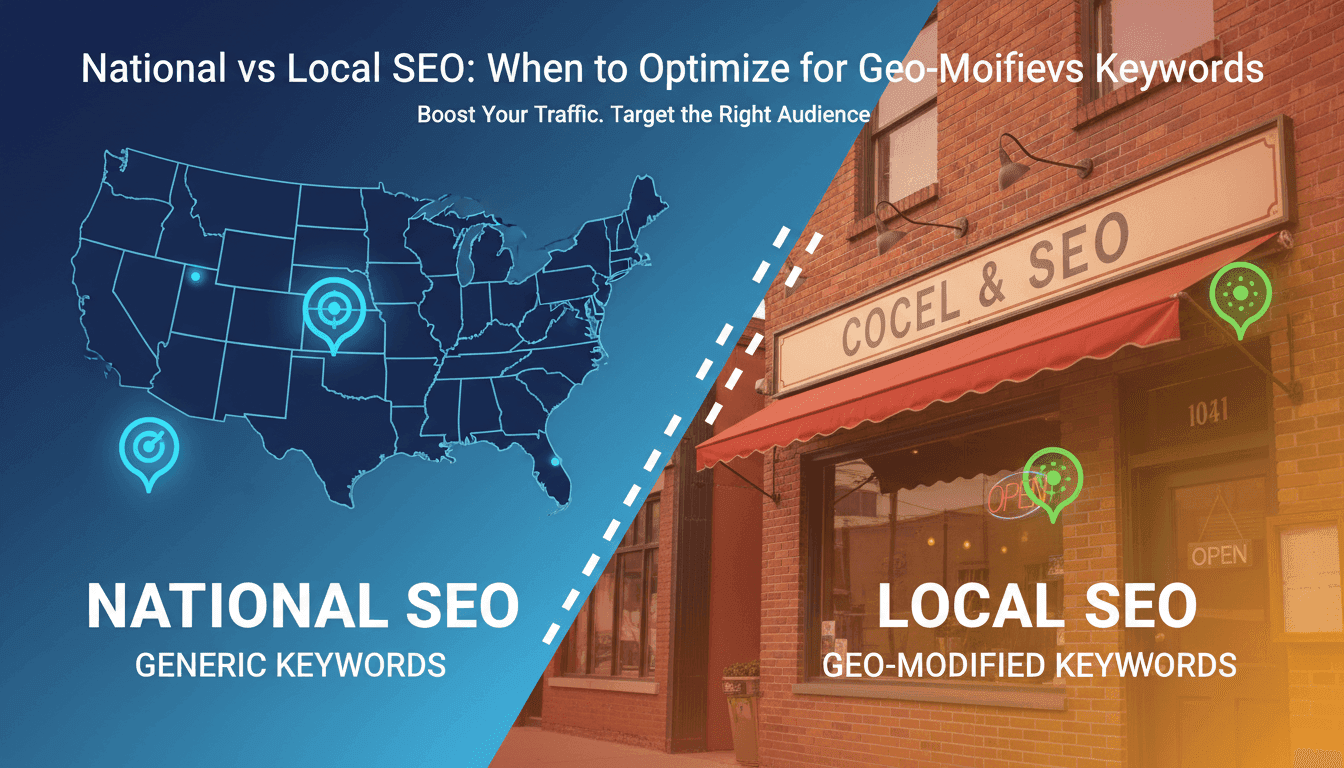
Table Of Contents
- What Is the Difference Between National and Local SEO?
- Understanding Geo-Modified vs Generic Keywords
- When to Prioritize Local SEO and Geo-Modified Keywords
- When National SEO and Generic Keywords Make More Sense
- The Case for a Hybrid SEO Strategy
- How AI Is Changing the Way Businesses Discover Local Keyword Opportunities
- Practical Steps to Build Your Keyword Strategy
- Conclusion
Introduction
Every business owner who has tried to rank on Google has faced the same fundamental question: should you optimize for broad, high-volume keywords or narrow your focus to location-specific searches? It sounds like a simple choice, but getting it wrong can mean burning your content budget on traffic that never converts into customers.
The debate between national SEO and local SEO is really a debate about intent — who is actually searching, what they need right now, and whether your business can realistically serve them. Geo-modified keywords (think "plumber in Austin" or "best Italian restaurant Chicago") signal immediate, location-aware intent, while generic keywords ("plumber tips" or "Italian pasta recipes") cast a much wider net with a very different kind of audience.
In this guide, we break down exactly when to lean into geo-modified keywords, when generic national terms are the smarter play, and how businesses of all sizes can build a keyword strategy that drives real leads rather than just rankings.
What Is the Difference Between National and Local SEO? {#difference}
National SEO is the practice of optimizing your website to rank for broad, non-location-specific keywords that can attract visitors from anywhere in the country (or world). It is the right strategy when your product or service can be delivered remotely, when you sell physical goods online, or when you are building brand authority across a wide geographic area. Think of a SaaS company, an e-commerce retailer, or a national insurance brand — their customers are not defined by a zip code.
Local SEO, on the other hand, is specifically designed to help businesses appear in location-based searches. When a user types "dentist near me" or "coffee shop in Brooklyn," Google surfaces results that are geographically relevant to that searcher. Local SEO encompasses everything from Google Business Profile optimization and localized landing pages to citation building and geo-modified keyword targeting.
The critical distinction is not just about geography — it is about the type of customer intent each approach captures. Local SEO captures high-urgency, high-conversion intent. National SEO often captures broader awareness and research-phase intent. Both have a role to play, but only one is right as your primary focus at a given stage of business growth.
Understanding Geo-Modified vs Generic Keywords {#keywords}
Before you build any SEO strategy, it helps to understand what each keyword type actually looks like in practice and what it signals about the searcher.
Geo-modified keywords include a geographic qualifier — a city, neighborhood, region, or even a "near me" phrase. Examples include:
- "emergency electrician Dallas"
- "yoga studio near me"
- "best roofing contractor in Phoenix"
- "accountant for small business Miami"
These searches almost always come from someone ready to take action. The person is not browsing. They have a specific need tied to a physical location, and they are likely to convert quickly if you appear at the right moment.
Generic keywords drop the location entirely and focus purely on the topic or service. Examples include:
- "how to fix a leaky faucet"
- "benefits of yoga for beginners"
- "roofing materials comparison"
- "small business accounting tips"
These searches attract people in the research or education phase. They may eventually become customers, but they are further from the buying decision. Ranking for generic keywords builds topical authority, drives traffic, and supports content marketing goals — but the lead quality is typically lower and the conversion path is longer.
The competition profile also looks very different. Generic keywords usually carry much higher search volumes but also far more competitive landscapes dominated by established media sites, Wikipedia, and large brands with massive domain authority. Geo-modified keywords often have lower volume but dramatically lower competition, making them far more achievable for small and mid-sized businesses.
When to Prioritize Local SEO and Geo-Modified Keywords {#local-seo}
Local SEO is not just for tiny mom-and-pop shops. It is the right primary strategy for any business whose customers are geographically constrained — meaning your ability to serve them depends on physical proximity.
Optimize for geo-modified keywords when:
- Your business operates from a physical location (restaurant, clinic, retail store, gym)
- You offer services that require an in-person component (plumbing, HVAC, landscaping, legal consultation)
- Your service area is limited to one or a few cities or regions
- You are a franchise or multi-location brand with distinct service territories
- You rely on walk-in traffic or local referrals as a core growth channel
The ROI case for local SEO is compelling. According to Google, 76% of people who search for something nearby on their smartphone visit a business within a day. Geo-modified keywords connect you with people at the exact moment of high purchase intent — and that specificity tends to produce leads that are far easier to close.
For businesses using platforms like LocalLead.ai, geo-targeted keyword optimization works hand-in-hand with local lead generation. When you align your on-page SEO with the same geographic and industry signals used by AI-powered lead discovery tools, you create a compounding effect: your site attracts inbound local prospects while the platform surfaces additional outbound opportunities in the same markets.
When National SEO and Generic Keywords Make More Sense {#national-seo}
National SEO earns its place when your business model is not geographically constrained, or when your goal is building brand awareness and topical authority rather than capturing immediate transactional intent.
Lean toward generic, national-scope keywords when:
- You sell digital products, software, or online services available to any customer regardless of location
- You run an e-commerce operation shipping nationwide or internationally
- Your growth strategy centers on content marketing and organic brand building
- You are competing for thought leadership in your industry (publishing guides, reports, or research)
- Your sales cycle is long and requires multiple touchpoints before a purchase decision
Content that ranks for generic keywords can drive substantial traffic over time and positions your brand as a trusted authority. A well-optimized blog post answering a common industry question can generate leads for years — even if those leads require more nurturing than someone searching for "plumber near me."
Agencies and AI-driven marketing services like Hashmeta's AI SEO Agents often use a national content strategy to build domain authority before layering in more specific, conversion-oriented keyword targeting. This approach works particularly well for B2B brands, tech platforms, and service businesses that operate across multiple industries or geographies.
The Case for a Hybrid SEO Strategy {#hybrid}
For many businesses, the most effective answer is not choosing between national and local SEO — it is building a deliberate hybrid strategy that leverages both types of keyword targeting at different stages of the funnel.
Imagine a multi-location fitness brand. At the national level, they might optimize for generic terms like "home workout routines" or "benefits of strength training" to build authority and attract top-of-funnel audiences. At the local level, each franchise location has its own landing page targeting geo-modified keywords like "gym in [city]" or "personal trainer [neighborhood]." The national content builds trust and brand equity; the local pages convert that trust into memberships.
This same model applies to service businesses, healthcare providers, legal firms, and professional services agencies. The key is maintaining a clean separation between content designed for broad awareness and pages designed for local conversion. Mixing intent signals — putting geo-modified keywords in a national blog post, for instance — confuses both users and search engines.
A hybrid approach also protects against algorithm volatility. If Google's local search rankings shift or your Google Business Profile loses visibility temporarily, your national content keeps generating traffic and leads. If your generic content faces stiff competition from major publishers, your local pages can still dominate the less-contested geo-modified searches in your markets.
How AI Is Changing the Way Businesses Discover Local Keyword Opportunities {#ai-seo}
Finding the right geo-modified keywords used to require hours of manual research across multiple tools. Today, AI is dramatically accelerating this process — and expanding what is possible for small and mid-sized businesses that lack large SEO teams.
Platforms like LocalLead.ai illustrate how AI transforms local business discovery. By converting business requirements into targeted keyword signals and conducting real-time web searches, these tools identify which local markets have active, relevant demand — essentially doing the competitor and audience research that informs smart keyword selection. Instead of guessing which geo-modified terms to pursue, businesses get data-driven direction aligned with where actual leads exist right now.
Similarly, AI SEO Managed Services use machine learning to analyze local search patterns, monitor competitor keyword movements, and surface geo-modified opportunities that manual research might miss. The result is a faster, more accurate keyword strategy that adapts to real market conditions rather than static historical data.
The rise of AI-powered search also means that geo-intent is increasingly inferred rather than explicit. A search for "best accountant" from a mobile device in Chicago may surface local results even without a geographic modifier. This makes it more important than ever to have your local SEO signals — location pages, Business Profile, citations, and structured data — fully aligned, because Google is making the geo connection on your behalf whether or not the searcher typed a city name.
Practical Steps to Build Your Keyword Strategy {#steps}
Whether you are leaning local, national, or hybrid, here is a practical framework for deciding which keyword types to prioritize:
-
Define your service delivery model — Can your customers be anywhere, or do they need to be near you? This single question determines whether local or national SEO is your primary focus.
-
Map your conversion funnel — Identify which keywords match each funnel stage. Geo-modified terms typically serve bottom-of-funnel intent; generic terms serve top and middle.
-
Audit existing rankings — Before creating new content, check whether you already rank (even partially) for any geo-modified or generic terms. Build on existing signals before starting from scratch.
-
Research local search volume and competition — Use keyword tools to compare search volume and keyword difficulty for geo-modified variations of your core service terms. In many markets, even modest local search volume converts better than high-volume generic traffic.
-
Create dedicated location pages for each service area — Do not stuff multiple cities into a single page. Each location deserves its own optimized page with unique content, local references, and geo-specific signals.
-
Align your content with AI-driven lead discovery — Use platforms like LocalLead.ai to validate that the geographic markets you are optimizing for actually contain active, qualified prospects. SEO and lead generation work best when they target the same high-opportunity markets.
-
Monitor and iterate monthly — Local search landscapes shift faster than national ones. New competitors enter markets, search patterns change seasonally, and Google's local algorithm updates frequently. Build monthly review cycles into your strategy.
Conclusion {#conclusion}
The choice between national SEO and local SEO, between geo-modified and generic keywords, comes down to one fundamental question: who is your customer and where are they when they need you? Businesses that serve customers in specific geographic areas will almost always see faster, higher-quality returns from geo-modified keyword targeting. Businesses with location-agnostic offerings benefit more from building broad topical authority through generic keyword content.
The most sophisticated businesses do not treat this as an either/or decision. They build layered strategies where national content drives brand authority and local pages capture high-intent, conversion-ready searchers. And increasingly, they are using AI-powered tools to identify exactly which markets and keyword combinations offer the best lead potential — removing the guesswork that has traditionally made keyword strategy feel more like art than science.
Getting your keyword strategy right is not just about rankings. It is about making sure the right person finds you at the right moment, in the right place. That is where SEO meets lead generation — and where the real ROI lives.
Ready to Find High-Intent Local Leads?
Stop guessing which local markets to target. LocalLead.ai uses AI to transform your business requirements into targeted keyword signals, identify active local prospects in real time, and deliver continuously updated, matched leads every month. Whether you are refining a geo-modified keyword strategy or exploring new service markets, LocalLead.ai gives you the data-driven direction to grow with confidence.