
The Future of B2B Lead Generation: How AI Is Transforming Business Growth
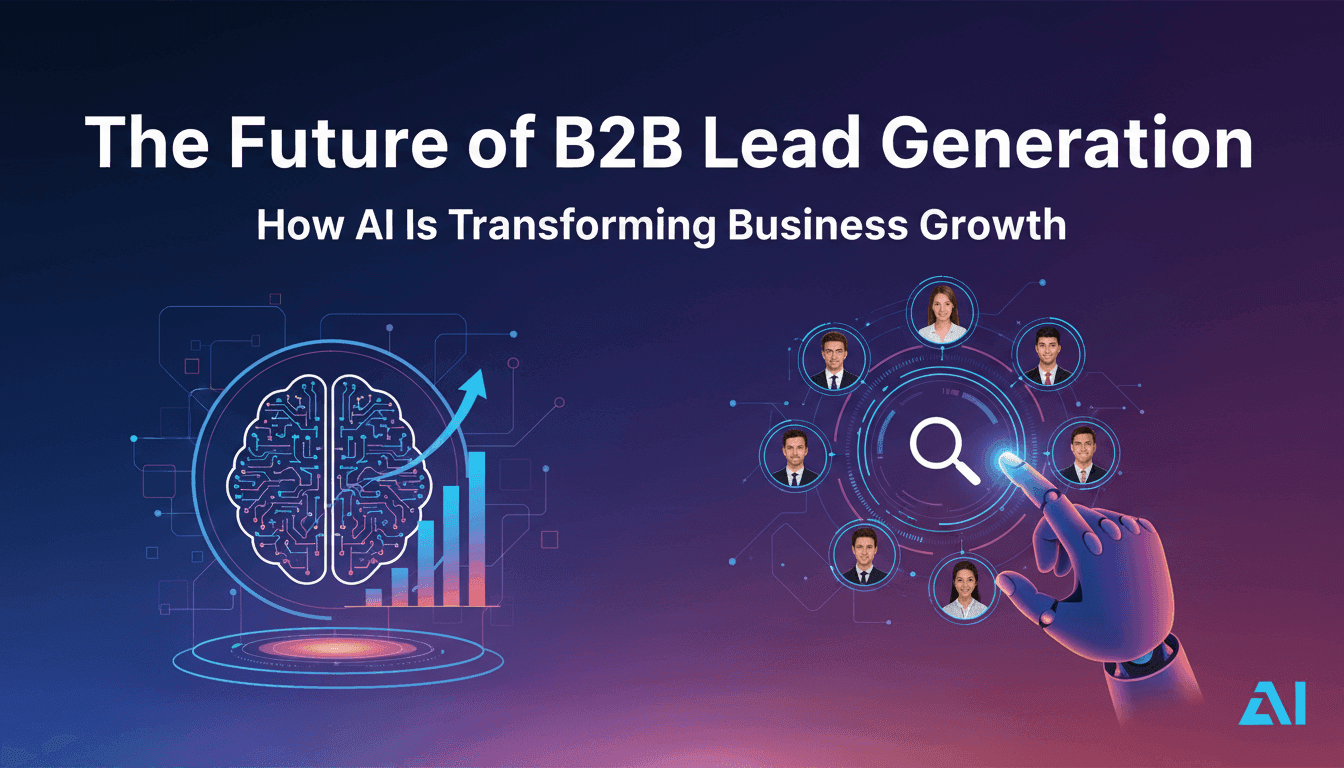
Table Of Contents
- The Evolution of B2B Lead Generation
- Why Traditional Lead Generation Methods Are Failing
- The AI Revolution in Lead Discovery
- Real-Time Data: The New Standard for Quality Leads
- Intelligent Matching and Scoring Systems
- The Rise of Continuous Lead Discovery
- Industry-Specific Lead Generation Strategies
- Integration with Modern Marketing Infrastructure
- Measuring ROI in Next-Generation Lead Generation
- Preparing Your Business for the AI-Driven Future
The landscape of B2B lead generation is undergoing its most significant transformation in decades. While businesses once relied on cold calling, purchased contact lists, and manual prospecting, the future belongs to organizations that harness artificial intelligence to discover, qualify, and engage prospects with unprecedented precision.
The statistics tell a compelling story: companies using AI-driven lead generation report up to 50% reductions in cost per lead while simultaneously improving lead quality metrics. This isn't just incremental improvement—it represents a fundamental shift in how businesses identify and connect with potential customers. The traditional pain points of outdated databases, poor lead-to-business fit, and time-intensive manual research are being eliminated by intelligent systems that work continuously in the background.
As we look toward the future of B2B lead generation, several transformative trends are reshaping the industry. From real-time web intelligence that captures business signals as they happen, to sophisticated matching algorithms that understand nuanced business requirements, the tools available today would have seemed like science fiction just five years ago. For forward-thinking organizations, the question is no longer whether to adopt AI-powered lead generation, but how quickly they can implement these systems to gain competitive advantage.
This article explores the technologies, strategies, and platforms defining the next era of B2B growth, offering practical insights for businesses ready to modernize their lead generation approach.
The Future of B2B Lead Generation
How AI Is Transforming Business Growth
The AI Revolution
Traditional methods are becoming obsolete
Why Traditional Lead Generation Fails
AI-Powered Lead Generation Advantages
The Evolution Timeline
Ready to Transform Your Lead Generation?
Discover how AI-powered platforms can revolutionize your B2B lead generation with real-time data, intelligent matching, and continuous discovery that delivers qualified prospects automatically.
Start Finding Better Leads TodayThe Evolution of B2B Lead Generation
B2B lead generation has traveled a remarkable journey from its early days of trade shows and telephone directories to today's sophisticated digital ecosystem. Understanding this evolution provides crucial context for appreciating where the industry is headed.
In the pre-internet era, businesses built prospect lists through industry publications, networking events, and purchased directories that were outdated almost immediately upon printing. The 1990s brought email marketing and early CRM systems, introducing digital scalability but often at the cost of personalization. The 2000s saw the rise of content marketing and inbound methodology, where businesses attracted leads through valuable content rather than interruption-based tactics.
The 2010s introduced marketing automation platforms that could nurture leads at scale, but still relied heavily on static databases and manual list building. Social selling emerged as LinkedIn and other platforms created new channels for business relationship development. Yet throughout all these advances, core challenges persisted: data quickly became stale, lead quality remained inconsistent, and significant human resources were required to research, qualify, and prioritize prospects.
Today, we stand at the threshold of the AI era—where intelligent systems can understand business requirements in natural language, continuously scan the web for relevant signals, and automatically match and score prospects based on sophisticated criteria. This represents not just another incremental improvement, but a paradigm shift that addresses the fundamental limitations of every previous generation of lead generation technology.
Why Traditional Lead Generation Methods Are Failing
Despite billions invested in sales and marketing technology, many businesses still struggle with lead generation effectiveness. The reasons for this persistent challenge reveal why a new approach is urgently needed.
Data decay undermines even the most expensive database subscriptions. Research indicates that B2B contact databases degrade at approximately 30% annually as professionals change roles, companies restructure, and businesses close or pivot. When your outreach is based on outdated information, you're not just wasting resources—you're damaging your brand reputation with misdirected communications.
Poor lead-to-business fit continues to plague organizations that rely on broad demographic targeting rather than intelligent matching. A company may fit your target industry and size profile but have no actual need for your solution, different technology infrastructure than you support, or budget constraints that make them unviable prospects. Traditional lead generation tools often lack the contextual intelligence to evaluate these nuanced fit factors.
Manual research bottlenecks limit scalability even when businesses are willing to invest in quality over quantity. Sales development representatives spending hours researching individual prospects can only process a fraction of the potential opportunities in their market. This manual approach simply cannot scale to match the pace of modern business.
Reactive rather than proactive discovery means businesses often learn about ideal prospects only after competitors have already engaged them. Without systems that continuously monitor the market for new opportunities, companies miss the critical early-stage engagement window when prospects are most receptive to new solutions.
These limitations aren't failures of execution—they're inherent constraints of approaches that depend on static databases and human-speed processing. The future demands systems that operate at digital speed with artificial intelligence.
The AI Revolution in Lead Discovery
Artificial intelligence is fundamentally transforming how businesses discover and qualify potential customers. Unlike previous technological advances that simply automated existing processes, AI introduces genuinely new capabilities that were previously impossible.
Modern AI local business discovery platforms can interpret complex business requirements expressed in natural language, translating strategic objectives into targeted search parameters without requiring technical expertise. This natural language processing capability means that instead of wrestling with complicated Boolean search strings or rigid database filters, users can simply describe their ideal customer profile as they would to a colleague.
These AI systems then conduct intelligent web searches that go far beyond simple keyword matching. They understand context, identify relevant signals, and distinguish between businesses that merely mention a topic and those actively engaged in related activities. Machine learning algorithms continuously improve their understanding of what constitutes a quality lead for specific use cases, learning from patterns in which prospects convert to customers.
Perhaps most importantly, AI platforms can process information at scales impossible for human teams. While a skilled researcher might thoroughly evaluate dozens of prospects per day, AI systems can assess thousands of potential leads, scoring and prioritizing them based on sophisticated matching criteria. This isn't about replacing human judgment—it's about ensuring that human expertise is applied to the highest-value opportunities identified through comprehensive market coverage.
The integration of AI with lead generation also enables predictive analytics that forecast which prospects are most likely to convert, optimal timing for outreach, and messaging approaches most likely to resonate based on company characteristics and behavior patterns. As businesses across industries embrace AI marketing services, lead generation becomes increasingly sophisticated and effective.
Real-Time Data: The New Standard for Quality Leads
The shift from static databases to real-time intelligence represents one of the most significant advances in B2B lead generation. Rather than working from periodically updated lists, next-generation platforms gather and analyze information dynamically, ensuring unprecedented accuracy and relevance.
Real-time lead generation systems continuously scan multiple data sources—company websites, news announcements, social media activity, job postings, technology implementations, and countless other signals—to identify businesses exhibiting behaviors or characteristics aligned with your ideal customer profile. When a company in your target market posts a job opening for a role that suggests they need your type of solution, you know immediately rather than learning about it months later from a quarterly database update.
This immediacy creates substantial competitive advantages. Early engagement with prospects, before they've been inundated with competitor outreach, dramatically improves response rates and conversion probability. Sales teams can reference specific, current information in their outreach, demonstrating genuine understanding rather than working from generic templates based on outdated data.
Real-time systems also excel at capturing intent signals—the digital behaviors that indicate active interest or need. When a prospect company suddenly increases content consumption around topics related to your solution, experiences executive changes that typically precede purchasing decisions, or shows technology adoption patterns that suggest readiness for your offering, real-time monitoring ensures you're aware and can respond strategically.
For businesses leveraging comprehensive platforms like Business AI, the integration of real-time lead data with other business intelligence creates a powerful foundation for strategic decision-making that extends beyond marketing into product development, competitive analysis, and market expansion planning.
Intelligent Matching and Scoring Systems
Not all leads are created equal, and the future of B2B lead generation lies in systems that understand nuanced fit criteria and automatically prioritize opportunities based on sophisticated analysis.
Traditional lead scoring typically relies on relatively simple point systems—company size, industry, website visits, email opens—that treat all factors as independent variables. Intelligent AI-driven scoring recognizes that lead quality depends on complex interactions between multiple factors. A small company in the right industry with recent funding and specific technology infrastructure might be a far better prospect than a large enterprise that technically fits your demographic profile but shows no behavioral intent signals.
Advanced matching algorithms evaluate leads across multiple dimensions simultaneously: firmographic fit (industry, size, location), technographic compatibility (existing technology stack), behavioral signals (content consumption, search activity, hiring patterns), temporal factors (funding events, leadership changes, seasonal business cycles), and competitive context (current vendors, switching costs, contract renewal timing).
These systems also learn from outcomes. By tracking which leads ultimately convert to customers and analyzing the characteristics they shared, machine learning models continuously refine their understanding of what constitutes a high-quality prospect for your specific business. This creates a virtuous cycle where lead quality steadily improves over time.
For organizations implementing intelligent matching, the benefits extend beyond sales efficiency. Marketing teams can craft more targeted campaigns when they understand precisely which prospects score highest and why. Product teams gain insights into which market segments show the strongest fit. Executive leadership can forecast pipeline with greater confidence when lead quality metrics are more predictive of actual conversion probability.
When combined with broader AI SEO Agents and content strategies, intelligent lead scoring ensures that the right prospects encounter the right messages at the right time in their buyer journey.
The Rise of Continuous Lead Discovery
The transition from periodic lead purchases to continuous discovery fundamentally changes how businesses build and maintain their sales pipeline. Rather than experiencing the feast-or-famine cycle of traditional lead generation—where purchased lists are worked to exhaustion before new leads are acquired—continuous discovery provides a steady stream of qualified prospects.
Modern AI-powered platforms operate 24/7, constantly searching for new businesses that match your criteria, monitoring existing prospects for signals that suggest increased readiness to buy, and removing leads that no longer fit your targeting parameters. This creates a dynamic, self-updating lead database that reflects current market conditions rather than a static snapshot from weeks or months ago.
Continuous discovery also enables businesses to capture time-sensitive opportunities that would be missed with periodic approaches. When a prospect company experiences a trigger event—leadership change, new funding, product launch, expansion to new markets—systems can immediately flag this and elevate the lead's priority. Sales teams can reach out while the information is fresh and the company is actively evaluating solutions.
For agencies and consultancies serving multiple clients, continuous discovery with monthly updates of tailored leads ensures consistent value delivery. Rather than one-time lead list deliveries, clients receive ongoing intelligence about their market, creating subscription-style relationships with predictable value generation.
The marketplace model emerging in platforms like LocalLead.ai takes continuous discovery even further, allowing specialists to create and sell industry-specific lead campaigns that leverage their domain expertise. A consultant with deep understanding of the healthcare IT market, for example, can design lead discovery campaigns specifically for that vertical and monetize their knowledge by offering those curated lead streams to businesses targeting that sector.
This shift toward continuous discovery aligns perfectly with modern SEO managed services and content marketing approaches, where consistent, ongoing effort yields compounding returns rather than one-time gains.
Industry-Specific Lead Generation Strategies
As lead generation technology becomes more sophisticated, the importance of industry-specific approaches becomes increasingly apparent. The signals that indicate a quality lead in healthcare differ dramatically from those in manufacturing, technology, professional services, or retail.
Industry-specific lead generation strategies account for unique buying cycles, regulatory environments, decision-making structures, and competitive dynamics. A platform targeting healthcare providers, for example, might monitor regulatory compliance requirements, accreditation status, patient volume indicators, and technology adoption patterns specific to medical facilities—factors largely irrelevant to manufacturing prospects.
The future of B2B lead generation includes increasingly specialized approaches that understand these vertical nuances. Rather than generic business databases with basic industry classifications, next-generation platforms incorporate domain-specific intelligence that recognizes the signals most predictive of purchase intent within particular sectors.
For businesses operating in niche markets, this specialization is particularly valuable. Generic lead generation tools often struggle to identify prospects in specialized industries because the relevant signals aren't part of their standard data collection. Industry-specific approaches can monitor trade publications, regulatory filings, certification databases, and other specialized sources that reveal opportunities invisible to generalized systems.
This trend toward specialization extends to platforms focused on specific discovery needs. Just as AI influencer discovery platforms have emerged to address the unique requirements of identifying and evaluating social media partners, industry-specific lead generation tools are developing to serve vertical markets with precision impossible in horizontal solutions.
Businesses should evaluate whether their industry has sufficient unique characteristics to benefit from specialized lead generation approaches, or whether their needs are well-served by configurable general platforms that can be tuned to industry-specific parameters.
Integration with Modern Marketing Infrastructure
Lead generation doesn't exist in isolation—it's one component of a broader marketing and sales technology ecosystem. The future belongs to platforms that integrate seamlessly with existing infrastructure rather than creating data silos or requiring wholesale replacement of established systems.
Modern lead generation platforms connect with CRM systems, marketing automation tools, sales engagement platforms, analytics solutions, and content management systems to create unified workflows. When a new lead is discovered and qualified, it should automatically flow into your CRM with all relevant intelligence attached, trigger appropriate nurture sequences in your marketing automation platform, and provide sales teams with contextual information to personalize their outreach.
This integration eliminates the manual data entry and system-switching that historically consumed substantial sales and marketing resources. It also ensures that lead intelligence informs decision-making across all customer-facing functions. When your content marketing team understands which topics resonate most with high-scoring leads, they can create more targeted content. When sales teams see which content pieces specific prospects have consumed, they can reference that in their conversations.
API-driven architectures enable businesses to build custom integrations that reflect their unique technology stack and workflows. Rather than forcing companies to adapt their processes to software limitations, flexible platforms adapt to support existing business logic while enhancing it with AI-powered intelligence.
For businesses working with AI agencies to implement comprehensive marketing technology solutions, lead generation platforms should be evaluated not just on their standalone capabilities but on how well they complement and enhance the broader system architecture.
The emergence of AI chat agents that can engage leads conversationally and social media agency capabilities that extend across platforms like Xiaohongshu demonstrate how integrated AI systems can manage entire customer engagement journeys with minimal manual intervention.
Measuring ROI in Next-Generation Lead Generation
As businesses invest in AI-powered lead generation platforms, measuring return on investment becomes both more important and more complex. The metrics that matter in next-generation systems extend beyond simple cost-per-lead calculations to encompass lead quality, conversion velocity, and long-term customer value.
Lead quality metrics should evaluate not just how many leads are generated, but how well they align with ideal customer profiles. Tracking what percentage of leads meet specific quality thresholds, how sales teams rate lead relevance, and what proportion of leads progress beyond initial contact provides much richer insight than volume alone.
Conversion rate analysis across different lead sources helps identify which discovery approaches yield the highest-quality prospects. AI-generated leads should demonstrate higher conversion rates than traditional sources when properly implemented, as the intelligent matching and scoring should eliminate low-probability prospects that consume sales resources.
Time-to-conversion comparisons reveal whether new lead generation approaches accelerate sales cycles. When leads enter your pipeline with more complete information, stronger intent signals, and better business fit, sales teams typically close deals faster, which impacts cash flow and resource efficiency even if total deal value remains constant.
Cost efficiency should account for both direct platform costs and the human resource time saved through automation. If an AI lead generation platform reduces the research time required per lead from 30 minutes to 5 minutes while generating higher-quality prospects, the labor savings alone may justify the investment before considering the improved conversion rates.
Attribution modeling becomes more sophisticated with AI-powered systems that track multi-touch engagement. Understanding which combination of lead sources, content interactions, and sales activities drive conversions enables continuous optimization of the entire revenue generation process.
For organizations implementing comprehensive approaches through partnerships with an SEO agency or influencer marketing agency, integrated analytics across all channels provide the most complete picture of marketing ROI and enable data-driven budget allocation decisions.
Preparing Your Business for the AI-Driven Future
Transitioning to AI-powered lead generation requires more than simply purchasing new software. Successful implementation demands strategic planning, organizational alignment, and commitment to new ways of working.
Start by auditing your current lead generation performance. Document your cost per lead, lead-to-opportunity conversion rates, opportunity-to-customer conversion rates, and average sales cycle length across different lead sources. These baseline metrics provide the benchmark against which you'll measure improvement and calculate ROI from new approaches.
Define your ideal customer profile with precision. AI systems are only as effective as the criteria they're given. Invest time in articulating not just demographic characteristics (industry, company size, location) but behavioral indicators (growth signals, technology adoption patterns, organizational changes) and contextual factors (competitive landscape, buying cycle timing) that distinguish high-probability prospects from superficial fits.
Prepare your team for a new workflow. Sales representatives accustomed to sourcing their own leads may initially resist AI-generated prospects, particularly if previous lead generation initiatives delivered poor results. Invest in change management, training, and early success stories that demonstrate the quality difference. Establish feedback loops where sales teams can rate lead quality so the system continuously improves.
Integrate with existing systems thoughtfully. Rather than creating parallel workflows where leads from different sources receive different treatment, implement integrated processes where all leads flow through consistent qualification, routing, and nurturing steps. This ensures fair evaluation and prevents AI-generated leads from being disadvantaged by unfamiliar processes.
Start with a pilot program that tests the approach with one business unit, product line, or geographic market before company-wide rollout. This allows you to refine parameters, optimize integration, and build internal success stories that facilitate broader adoption.
Plan for continuous optimization. AI-powered lead generation isn't a set-it-and-forget-it solution. Plan for regular review of lead quality metrics, conversion performance, and targeting parameters. As your business evolves, your ideal customer profile may shift, requiring corresponding adjustments to your lead discovery criteria.
Businesses implementing influencer marketing platforms have discovered that the most successful deployments combine sophisticated technology with human expertise and strategic oversight. The same principle applies to AI-powered lead generation—technology amplifies human capability rather than replacing it.
The organizations that thrive in the next decade will be those that embrace AI-driven approaches while maintaining the strategic thinking, relationship building, and solution expertise that technology cannot replicate. The future of B2B lead generation is not humans versus machines, but humans empowered by intelligent systems that handle data processing, pattern recognition, and continuous monitoring at scales impossible for manual approaches.
The future of B2B lead generation has arrived, and it's fundamentally different from anything that came before. AI-powered platforms that deliver real-time intelligence, intelligent matching, and continuous discovery are replacing the static databases and manual research processes that have dominated for decades.
For businesses willing to embrace this transformation, the benefits are substantial: higher-quality leads that better match ideal customer profiles, more efficient use of sales and marketing resources, faster identification of time-sensitive opportunities, and ultimately, improved conversion rates and revenue growth. The organizations that hesitate while competitors adopt these capabilities risk finding themselves at a severe disadvantage in an increasingly competitive landscape.
The transition to AI-driven lead generation isn't without challenges. It requires investment in new platforms, changes to established workflows, and commitment to data-driven approaches over intuition and habit. But the evidence is clear: businesses leveraging modern lead generation technology are outperforming those relying on traditional methods by significant margins.
As you consider your lead generation strategy going forward, ask yourself whether your current approach can scale to meet your growth objectives, whether your lead quality metrics are trending in the right direction, and whether your sales teams are spending their time on high-value activities or drowning in unqualified prospects and outdated data. The answers to these questions will reveal whether the time has come to modernize your approach.
The future of B2B lead generation is not a distant possibility—it's a current reality that forward-thinking businesses are leveraging today. The question is not whether AI will transform how companies discover and engage prospects, but whether your organization will be among the early adopters that capture competitive advantage or the late followers struggling to catch up.
Ready to Transform Your Lead Generation?
Discover how LocalLead.ai can revolutionize your B2B lead generation with AI-powered discovery, real-time data, and intelligent matching that delivers qualified prospects continuously.